




Peak Shaving with BESS: How to Cut Demand Charges and Take Control of Your Electricity Bill
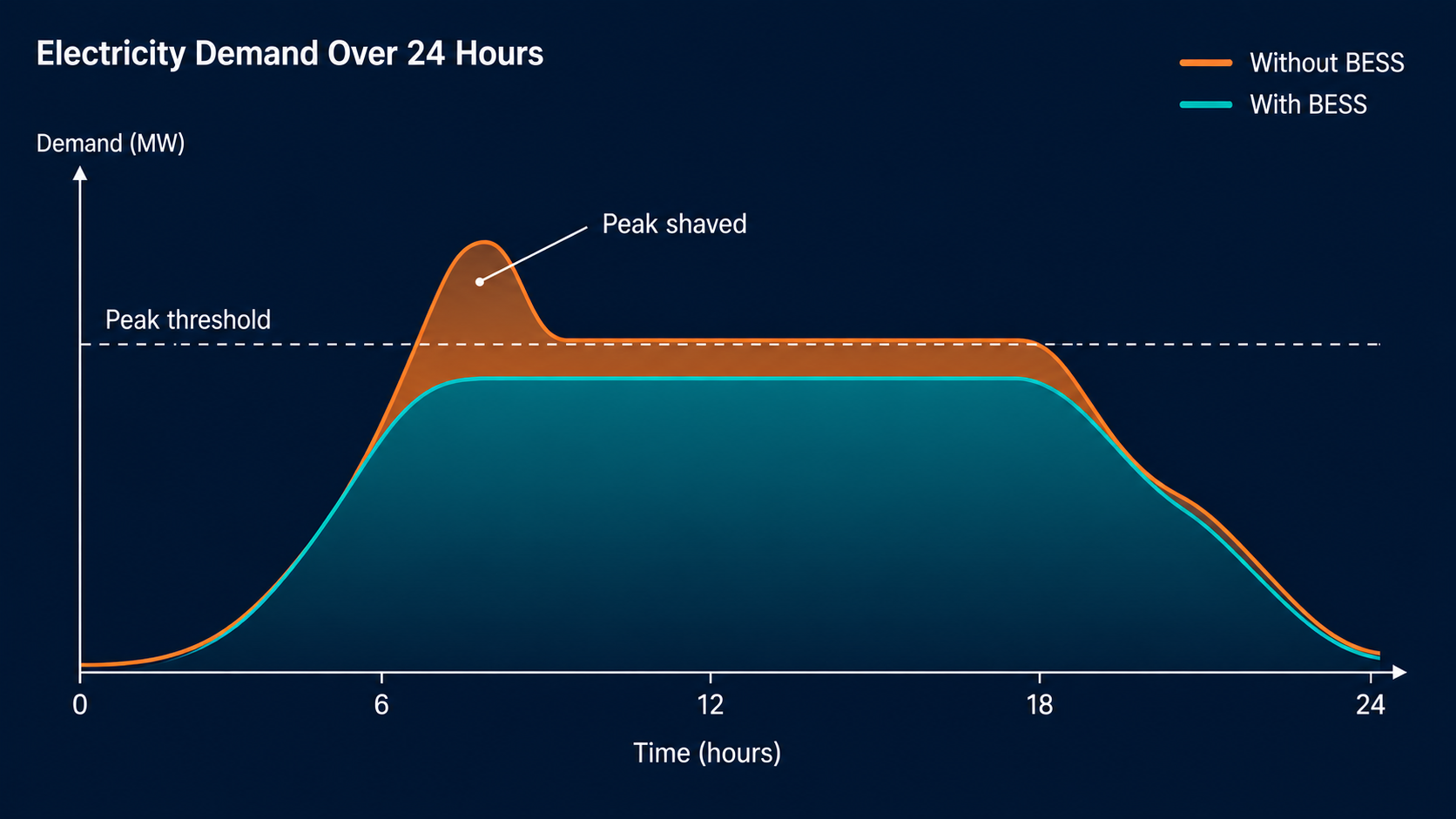
Demand charges can account for 30–40% of a commercial electricity bill — and a single 15-minute window can set your rate for the entire month. Here is how battery storage, solar, and predictive load management are changing that equation across Europe.
The part of your electricity bill that punishes peaks
Most energy conversations focus on consumption — how many kilowatt-hours you use, and at what price per kWh. But for commercial and industrial sites across Europe, a second charge often matters just as much: the demand charge, billed based on the highest power draw recorded during a short measurement interval — typically 15 or 30 minutes — within the billing period.
The mechanism is the same: one brief spike — multiple large loads switching on simultaneously, a production ramp-up, an EV charger activating — can define your peak and inflate your bill for the entire month.
30–40%
of C&I bills from demand charges
£7.26/kVA
UK monthly rate, 2025/26 (>100 kVA)
15 min
Measurement window that sets your peak
1 spike
Sets the rate for the entire month
To illustrate the scale: a large industrial site with a 35 MW peak demand can face demand charges in the millions of euros annually. But the same principle applies at any scale. A commercial building with a 500 kW contracted capacity, drawing an unexpected 620 kW during a 15-minute window, will be billed on 620 kW for the whole month — regardless of how efficiently it consumed energy for the other 43,185 minutes.
What peak shaving means in practice
Peak shaving is the practice of keeping your maximum grid draw below a defined threshold, smoothing the load profile so that expensive demand peaks never register. The available approaches differ significantly in complexity, cost, and operational impact — and they work best in combination.
Load curtailment
Switch off non-critical loads during peak windows. Low cost to implement, but directly impacts operations. A last resort, not a strategy.
BESS dispatch
Battery discharges the moment demand approaches the threshold. Operations continue uninterrupted. The grid never sees the spike.
Solar self-consumption
On-site solar reduces base grid demand during daylight hours, lowering the starting point from which peaks are measured.
Predictive EMS
Forecasts tomorrow’s load profile, weather, and price signals. Pre-positions the battery before the peak arrives — not just after.
Why BESS is the operational core
Load curtailment has a ceiling: at some point, reducing demand means stopping production. Solar helps but cannot be dispatched on demand. Battery storage is different — it is controllable, fast-responding, and sized precisely to the peak reduction target.
The mechanics are direct. The BESS monitors real-time consumption against a defined threshold. The instant demand approaches that ceiling, the system discharges automatically to supplement grid supply, preventing the spike from registering on the meter. The battery recharges during overnight low-tariff windows or midday solar surplus periods — when energy is cheapest, or on dynamic tariff sites, sometimes negative.
The connection to price arbitrage is direct: a BESS that charges during negative or low-price hours simultaneously builds the reserve it needs for peak shaving later in the day. The same hardware captures value from both use cases, which is why payback periods on commercial storage are compressing.
Sizing for real C&I sites: what one Sentinal unit can do
It is worth grounding the economics in a realistic scale. A single ZTTEK Sentinal unit (261 kWh) deployed at a commercial or light industrial site with a 500 kW contracted capacity works as follows:
Worked example — 500 kW contracted site, one Sentinal 261 kWh unit
- Contracted capacity: 500 kW
- Typical morning demand spike (without BESS): 620 kW
- Peak shaving target (Sentinal discharge): ~150–200 kW
- Metered peak with BESS active: ~480 kW
- Demand charge saving (at €10/kW/month): ~€1,400/month
- Annual demand charge saving: ~€16,800/year
This is before accounting for energy arbitrage (charging at low-tariff hours, discharging at peak-tariff hours), solar self-consumption improvement, or any grid flexibility revenue the system may be eligible for. In markets with significant peak/off-peak spreads, the combined value stack can materially shorten the payback period.
For sites with higher peak variability or multiple daily peak events, two or more units can be deployed in parallel, scaling the shaving capacity proportionally.
The forecasting layer: from reactive to predictive
A battery that only responds to what is happening now is useful. A system that anticipates what will happen tomorrow is significantly more valuable — and the difference is an Energy Management System with load forecasting capability.
Predictive EMS integrates several data streams to pre-position the battery before a peak arrives:
- Historical load patterns for the site, identifying which days and times reliably produce peaks
- Weather forecasts, which predict HVAC load, solar output, and seasonally driven demand shifts
- Production or operational schedules, identifying when heavy equipment will be switched on
- Day-ahead electricity price signals, optimising the charge/discharge cycle for both peak avoidance and arbitrage simultaneously
The practical effect: instead of the BESS starting its discharge response when demand is already rising, the system charges fully during the night, holds reserve at the right state of charge ahead of the forecast peak window, and dispatches precisely. This also reduces the risk of the battery being partially depleted from a morning arbitrage cycle when it is needed most for afternoon peak shaving.
For EV charging sites — an increasingly common C&I load category — this forecasting layer is critical. A fleet charging hub that pre-schedules charging around expected peak windows, rather than allowing simultaneous uncontrolled charging, can reduce its measured demand peak by 20% or more without any impact on charging availability.
Where demand charges are highest across Europe
🇬🇧 United Kingdom
£7.26/kVA/month for consumers above 100 kVA (2025/26). Triad system: three winter half-hour settlement periods determine annual transmission charges. BESS is essential for Triad avoidance.
🇩🇪 Germany
Leistungspreise (capacity charges) under BNetzA-regulated network tariffs, billed in kW. Smart meter rollout targeting 95% of high-consumption sites by 2030, enabling dynamic demand response.
🇮🇹 Italy
Componente di potenza (power component) applies to C&I users, billed in kW. Italy also curtails 2–4 TWh of renewables annually — creating localised price spikes that peak shaving hedges against.
🇧🇪🇳🇱 Benelux
Contracted capacity limits with exceedance penalties, billed in kW. Belgium extended capacity tariffs to prosumers in 2023 — a signal that demand-based billing is expanding beyond large C&I.
🇪🇸 Spain
Peaje de acceso (access tariff) includes a power component billed in kW across six time discrimination periods (P1–P6). The P1 peak period rate is significantly higher than off-peak bands, meaning demand spikes during peak hours carry a disproportionate cost. Spain also recorded 397 hours of negative electricity prices in Q1 2026 — the flip side of the same renewable-heavy grid that creates sharp peak pricing during constrained periods.
🇫🇷 France
TURPE network tariff includes a subscribed capacity component in kVA. Capacity market reform in 2026 is reshaping how C&I sites manage peak exposure.
🇳🇴🇸🇪🇫🇮 Nordics
Power-based distribution tariffs (PBT) rolling out now, shifting billing from volumetric kWh to peak kW. Finland leading implementation. Makes peak shaving relevant for mid-size commercial sites for the first time.
The EU policy direction: peak-based billing is expanding
The EU’s grid package expected in 2026 is pushing member states toward cost-reflective, peak-sensitive network tariffs. ACER concluded in July 2025 that formalised grid-level peak-shaving products are not yet recommended for normal market conditions — meaning site-level storage remains the primary tool for C&I operators managing demand cost. The direction of tariff reform is clear: as EV adoption, data centre growth, and heat pump uptake add volatile new loads to the grid, network costs will increasingly be allocated based on when you draw power, not just how much.
What to look for in a C&I peak shaving BESS
Key parameters for peak shaving duty cycles: response speed (the system must react within seconds of threshold approach), power-to-energy ratio (peak shaving often requires high power output for short durations), round-trip efficiency (directly affects the cost per cycle), and EMS integration capability (forecasting and real-time load control).
ZTTEK’s Sentinal C&I energy storage system is built on LFP chemistry with integrated EMS connectivity, designed for the high-cycle, high-response-speed demands of commercial peak shaving. Individual units of 261 kWh can be deployed as standalone systems or scaled in parallel for larger sites, with full compatibility with solar PV integration and dynamic tariff optimisation.
Conclusion
Demand charges are rising. Tariff structures across Europe are moving toward peak-based billing. EV fleets, data centres, and heat pumps are adding unpredictable new loads to commercial sites. A BESS with predictive EMS is no longer a nice-to-have — it is the most reliable, operationally non-disruptive way to manage peak exposure while simultaneously capturing value from price arbitrage and solar self-consumption.
The spike that sets your monthly rate should never reach the meter.
Check out more on ZTTEK BESS solutions:
Sentinal 261 C&I Energy Storage Cabinet
Sentinal 100 C&I All-in-one BESS