




Negative Electricity Prices in Europe: How BESS Turns a Grid Crisis into Savings for Businesses and Homeowners
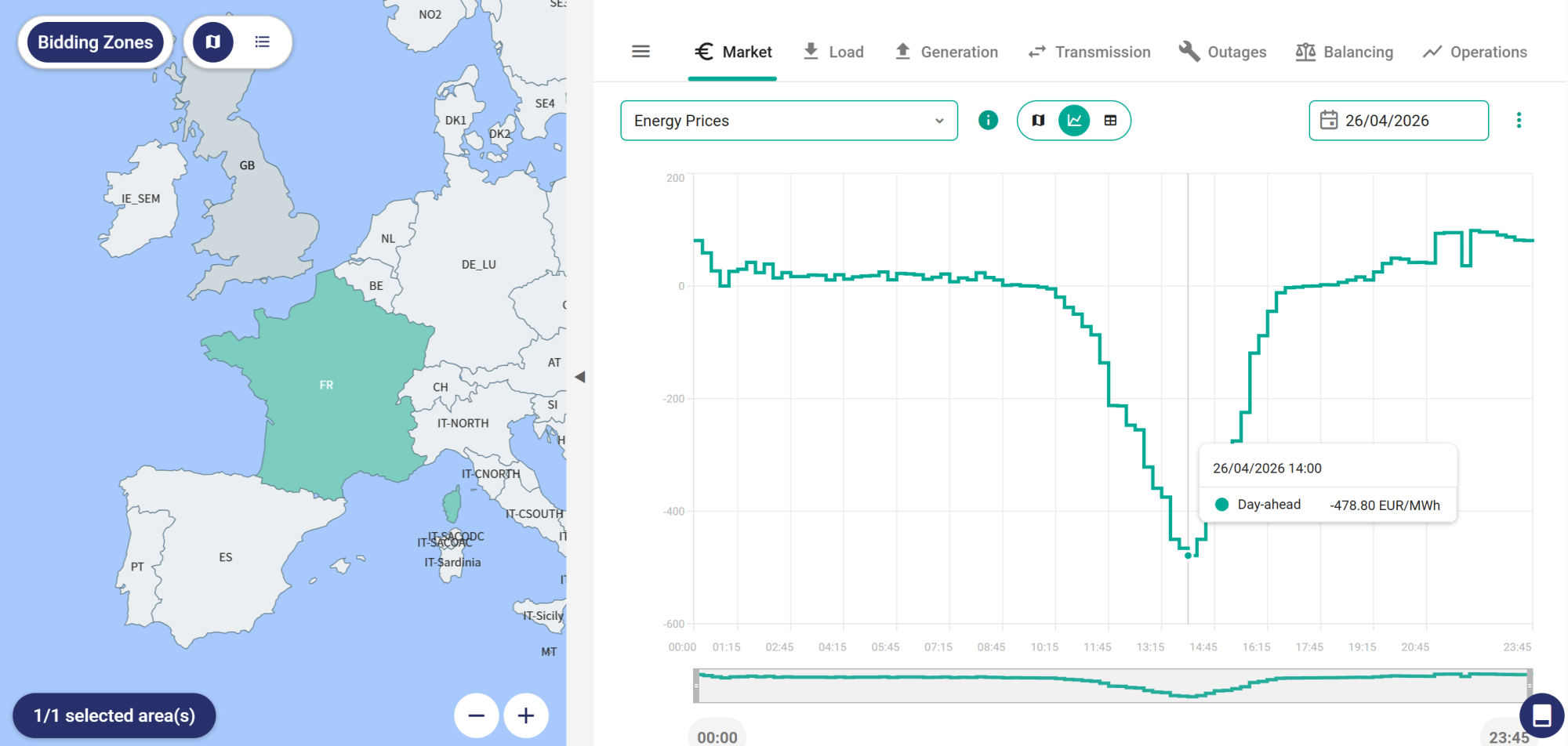
Day-ahead prices hit -478 €/MWh in France. -257 €/MWh in Hungary. Spain logged 397 hours of negative prices in Q1 2026 alone. What sounds like a market anomaly is now a recurring reality — and for energy storage owners, it’s an opportunity.
What are negative electricity prices — and why are they becoming normal?
Negative electricity prices occur when supply on the grid exceeds demand, forcing generators to pay to offload power rather than curtail output. In spring 2026, a combination of strong solar irradiation, significant wind generation, and low weekend industrial demand pushed day-ahead prices across Central and Western Europe deep into negative territory simultaneously.
Inflexible generators — nuclear plants, lignite units, CHP plants tied to heat contracts — cannot simply switch off. They will accept a negative price to stay online. Meanwhile, interconnectors between countries hit their capacity limits, so surplus power cannot always flow to where it is needed (as seen by the contrast between Germany at -200 €/MWh and Great Britain at +77 €/MWh on the same afternoon).
This is not a one-off event. Spain recorded 397 hours of negative prices in Q1 2026, up from just 48 hours in Q1 2025. As solar capacity continues to grow and electrification increases grid complexity, negative price hours will become a structural feature of European power markets.
| Spain negative price hours, Q1 2026 | France day-ahead low, April 2026 | Hungary forecast low | Increase in Spain negative hours YoY |
| 397 h | -478 €/MWh | -257 €/MWh | 8× |
How a battery storage system captures value from negative prices
A battery energy storage system (BESS) is uniquely positioned to benefit from price volatility in both directions. The core value mechanism is simple: charge when prices are at their lowest (or negative), discharge when prices are highest.
Energy arbitrage: buy low, sell (or self-consume) high. When grid prices are negative, charging your battery is not just free — in markets where dynamic tariffs or real-time pricing apply, utilities may effectively pay you to absorb surplus energy.
In practice, value stacking means a BESS captures revenue across multiple services simultaneously: price arbitrage, peak demand shaving, backup power resilience, and in some markets, grid frequency regulation services.
Impact for C&I users: reducing the electricity bill at scale
Peak shaving and demand charge reduction
For commercial and industrial sites, electricity bills are often dominated not by energy consumption (kWh) but by peak demand charges (kW). A large factory or distribution centre that briefly draws high power during morning ramp-up can face disproportionate capacity charges. A C&I BESS — such as the ZTTEK Sentinal series — pre-charges during low-price or negative-price hours and discharges precisely during peak demand windows, flattening the load profile and cutting demand charges significantly.
Arbitrage on dynamic tariffs
As time-of-use and real-time pricing tariffs become more widespread across European markets, C&I buyers with dynamic contracts are directly exposed to the price swings described above. A business paying spot-linked prices on a Saturday afternoon in April 2026 would have been paid to consume. With a BESS, that consumption is stored, not wasted, and can be deployed during the evening peak when prices recover. The spread between negative midday prices and positive evening prices routinely exceeds 200–300 €/MWh on high-renewable days.
Grid resilience and power quality
Beyond cost savings, C&I operators benefit from improved energy resilience. With grid volatility increasing alongside the share of weather-dependent renewables, having on-site storage provides continuity of supply during price spikes, grid stress events, or local outages — a significant value for manufacturing, data centres, and cold chain logistics.
Impact for residential users: smarter self-consumption
For homeowners with rooftop solar, a home battery system changes the economics fundamentally. Without storage, solar generation that exceeds household consumption at midday is typically exported to the grid at low (or zero) feed-in tariff rates. With a residential BESS — like the ZTTEK HEARTH series — that excess generation is stored and used in the evening, when grid tariffs are higher.
Self-consumption maximisation
A well-sized home battery allows households to achieve 70–90% solar self-consumption, dramatically reducing dependence on grid power during high-tariff hours. On days when negative prices coincide with low solar output (e.g. cloudy mornings), a smart system can also charge from the grid, effectively absorbing free or subsidised energy for later use.
Protection from retail tariff volatility
Even where retail customers are not on dynamic tariffs, rising wholesale volatility puts upward pressure on fixed tariffs over time. Investing in residential storage now locks in a hedge against future retail price increases — a compelling case as European power markets structurally reshape around renewables.
In Germany, France, Belgium, Spain, and neighbouring markets, the combination of falling BESS hardware costs and increasing negative price frequency is shortening payback periods and strengthening the investment case for both C&I and residential storage year on year.
Choosing the right BESS: what to consider
Not all storage systems are equal when it comes to capturing arbitrage value. Key factors include: round-trip efficiency (how much energy is retained through a full charge-discharge cycle), cycle life (how many cycles the battery can perform over its lifetime), response speed (critical for frequency regulation services), and software intelligence (whether the system can optimise dispatch against price forecasts automatically).
ZTTEK’s Sentinal C&I ESS and HEARTH residential ESS are built on lithium iron phosphate (LFP) chemistry, which offers excellent cycle life, thermal stability, and safety — well suited to the high-frequency cycling that price arbitrage strategies require.
Conclusion: the grid is changing — storage is the answer
Negative electricity prices are no longer anomalies. They are signals: the grid has more renewable energy than it can absorb at certain hours, and that gap will grow. For C&I energy managers and homeowners with solar, a BESS is the tool that converts grid volatility from a risk into a competitive advantage — reducing bills, improving resilience, and accelerating the return on solar investment.
The question is no longer whether to invest in energy storage. It is how quickly you can start capturing the opportunity.
Is your energy strategy ready for that?
Check out more on ZTTEK BESS solutions:
Sentinal 261 C&I Energy Storage Cabinet
Sentinal 100 C&I All-in-one BESS
Hearth Residential Battery Energy Storage System (8kWh, High-voltage, Stackable)
Hearth Residential Battery Energy Storage System (16kWh, Low-voltage, Stackable)
Hearth Residential Battery Energy Storage System (16kWh, Low-voltage, Floor-standing)
Picture source: ENTSO-E Transparency Platform