




Italy’s C&I BESS Market Is Entering Its Growth Phase — Key Takeaways from Key Energy 2025
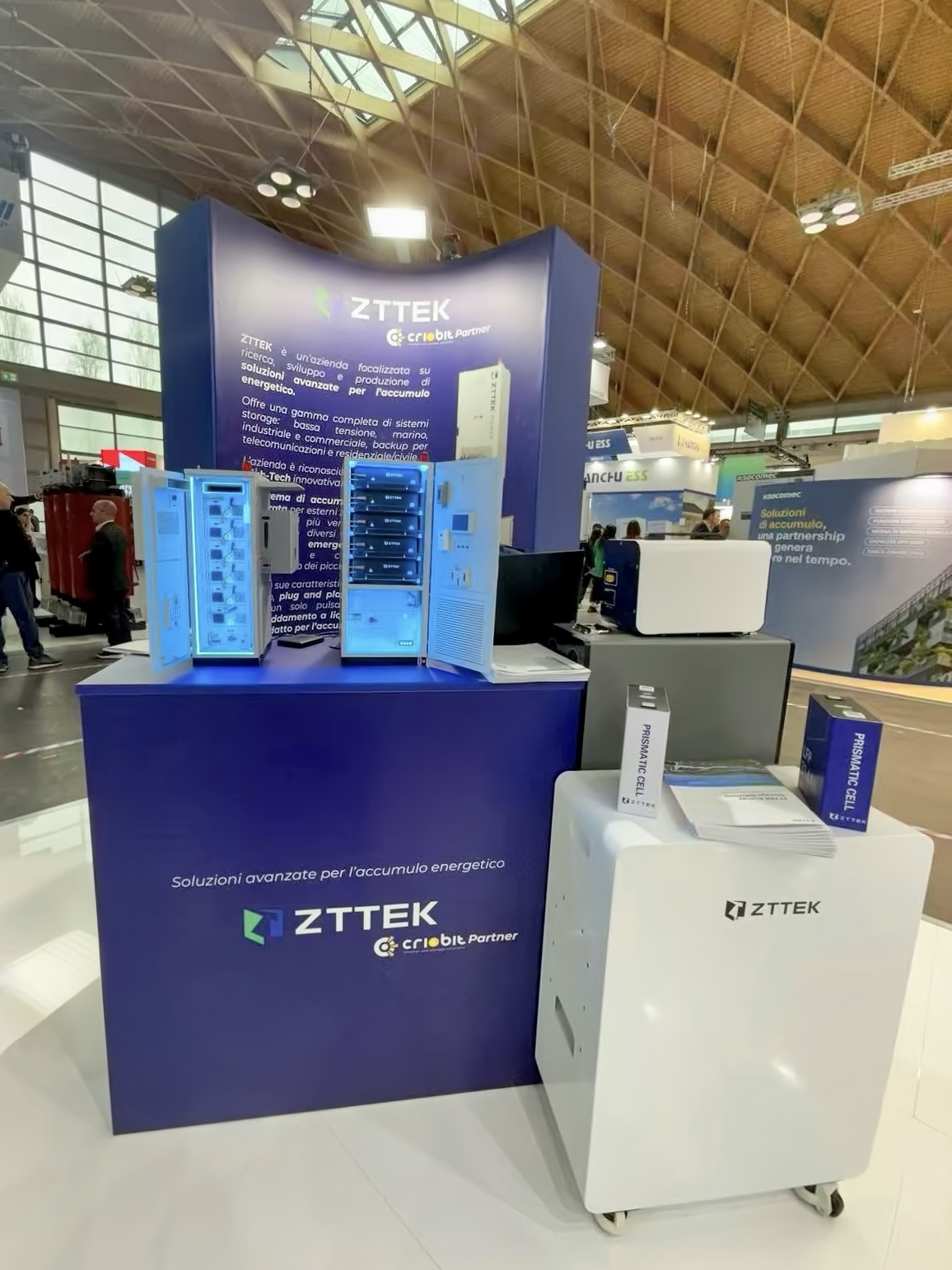
We joined thousands of energy professionals at Key Energy in Rimini this March — one of Italy’s most established platforms for the renewable energy and storage industry. Between the conversations on the show floor and the broader signals coming from Italian energy policy, one thing is clear: the commercial and industrial BESS segment in Italy is moving from early adoption into genuine scale.
Here’s what the market looks like right now, and why it matters.
Italy’s Storage Market: The Numbers Behind the Momentum
Italy’s utility-scale storage numbers have been making headlines, and rightly so. Installed BESS capacity grew from 507 MWh in 2023 to 3,359 MWh in 2024 — a near-sevenfold increase in a single year — driven largely by large standalone projects incentivized through grid capacity market auctions.
But utility-scale growth alone doesn’t tell the full C&I story. The more important shift for commercial and industrial users is happening at the policy level, where a combination of incentive changes and market structure reforms is making behind-the-meter storage increasingly compelling.
Italy’s cumulative installed storage base reached over 6,600 MWh by end of 2023, with the majority still composed of residential systems below 20 kWh. The C&I segment has significant room to grow — and the regulatory environment is now actively pushing it there.
The Policy Signals That Matter for C&I Operators
The Eco-bonus tax credit. Italy currently offers a 50% tax credit for qualifying storage installations in 2025, stepping down to 36% by 2027. For C&I projects where capital cost recovery timelines are a primary concern, this window represents a meaningful financial lever — and one with a defined expiration date.
The end of Scambio sul Posto. Italy is phasing out its historic net-metering mechanism (“Scambio sul Posto”), which allowed small producers to exchange surplus solar generation with the grid on a simple one-for-one basis. As this scheme winds down, businesses that have relied on net metering to make their solar assets work financially are now facing a fundamental change in economics. The alternative — pairing solar with on-site storage to maximize self-consumption — becomes the logical response. This regulatory shift is arguably the single biggest structural driver for C&I BESS demand over the next two to three years.
Renewable Energy Communities (CERs). Italy’s implementation of the EU’s RED II Directive includes specific incentives for collective self-consumption within energy communities. CER configurations create a new context in which behind-the-meter storage on both the production and consumption side is advantageous — a use case that’s generating real interest among industrial parks, multi-tenant commercial properties, and municipal operators.
The MACSE framework. While primarily designed for utility-scale standalone storage, Italy’s new Energy Storage Capacity Procurement Mechanism (MACSE) — offering 15-year tolling contracts with Terna, the national grid operator — signals a long-term institutional commitment to storage infrastructure. Its first auction is scheduled for September 2025. For the C&I market, the significance is indirect but real: MACSE clarifies that Italy views storage as critical infrastructure, which reduces perceived regulatory risk for all storage investments.
What C&I Buyers in Italy Are Actually Asking About
The conversations at Key Energy confirmed a few consistent themes from Italian C&I buyers and developers:
Revenue stacking complexity. Italian operators are increasingly sophisticated about value stream optimization — they want to understand how a system can simultaneously handle peak demand reduction, self-consumption maximization, and potentially participate in ancillary service markets. The ability of the EMS (Energy Management System) to manage multiple value streams in real time is a key differentiator, not an afterthought.
Grid connection constraints. For industrial sites with significant solar installations, grid injection limitations in certain zones — particularly in southern Italy, where renewable penetration is highest — are making on-site storage a near-necessity rather than an option. Projects in the south also benefit from wider day-ahead price spreads, improving the economics of arbitrage-based operation.
Safety and certification. With the Italian market maturing rapidly, buyers are paying closer attention to product certifications, fire safety standards, and compliance with local grid codes. This is a positive sign of market maturation, and one that rewards suppliers who invest in doing the compliance work properly.
Total cost of ownership, not just capex. Italian C&I operators tend to think in lifecycle terms. Questions about degradation curves, cycle warranties, and O&M support structures are common — and separating yourself from suppliers who only talk about upfront price is increasingly achievable for those who can demonstrate credible long-term performance data.
Our Presence at Key Energy
We were at Key Energy to present our C&I BESS solutions and engage directly with the Italian market.
The show provided a valuable cross-section of the Italian storage ecosystem: developers, EPCs, industrial energy managers, utilities, and financiers. The level of technical sophistication in the conversations — compared to even two or three years ago — reflects how quickly this market is professionalizing.
Looking Ahead
Italy has set a target of 11 GW of standalone utility-scale storage capacity by 2030, against an installed base of roughly 1 GW today. The C&I segment sits alongside this buildout as a parallel opportunity — one that is driven by different economics (behind-the-meter value, self-consumption, demand charge management) but equally underpinned by Italy’s fundamental need to integrate a rapidly growing renewable generation base.
The Eco-bonus window is open. The net-metering transition is underway. The grid is tightening in high-solar zones. For C&I operators in Italy, the question is less “whether” to deploy storage and more “how to deploy it well.”
That’s exactly the conversation we’re built to have.
Interested in understanding how our C&I BESS solutions apply to the Italian market? Contact us / Learn more about our products.
Sentinal 261 Energy Storage Cabinet
Sentinal 100 C&I All-in-one BESS